 Save to Pinterest
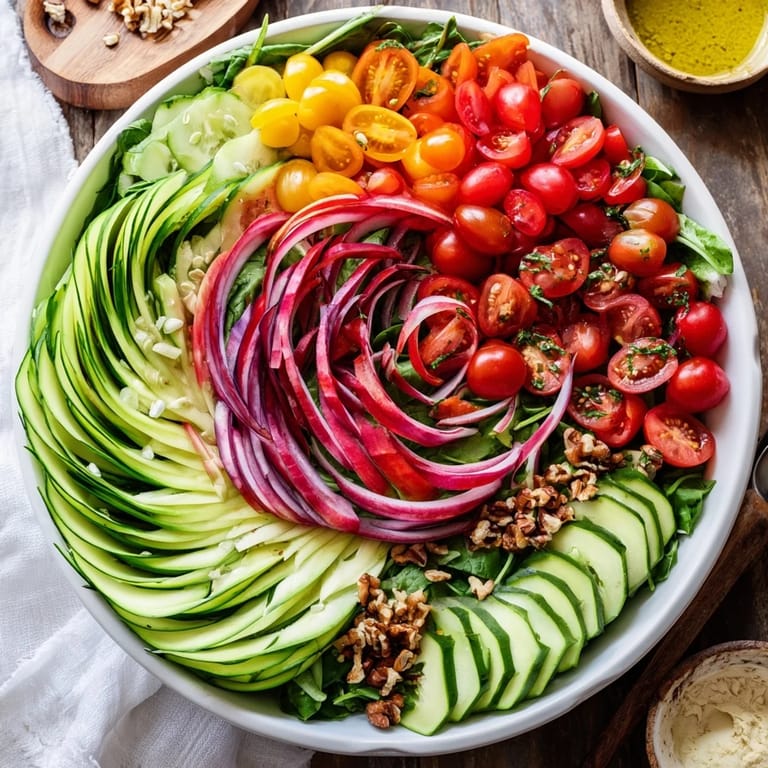
 I stumbled onto the Fibonacci spiral while scrolling through a design blog one Tuesday evening, and something clicked—what if I arranged salad ingredients the same way? The mathematical spiral that shows up everywhere in nature suddenly felt like permission to make food that was as beautiful to look at as it was to eat. My first attempt was chaotic, with arugula tumbling everywhere, but when I finally nailed the expanding fan pattern, I realized I'd created something that guests would photograph before they even touched it.
I made this for a dinner party last spring when I was nervous about hosting for the first time, and the moment my friend Sarah walked in and said, "Wait, did you actually arrange that?" something shifted. Suddenly I wasn't anxious anymore—I was just proud of this ridiculous, beautiful thing I'd created on a plate. That's when I understood that food doesn't have to be complicated to feel special.
Ingredients
- Baby spinach leaves: Use the tender inner leaves as your spiral's foundation—they're mild enough not to compete with everything else.
- Arugula: This peppery green adds bite that cuts through the sweetness of the blueberries and avocado.
- Cherry tomatoes: Halve them so they sit flat in the spiral and catch the light beautifully.
- Cucumber: Keep the slices thin and uniform so they layer smoothly in your expanding sections.
- Radishes: Their crunch and slight sharpness prevent the whole thing from feeling too soft or one-note.
- Red onion: Slice it paper-thin so it reads as a delicate accent, not an overpowering punch.
- Avocado: Add it just before serving to prevent browning, and choose one that's ripe but still holds its shape.
- Blueberries: They nestle into gaps in the spiral and add unexpected sweetness and color.
- Toasted walnuts: Toast them yourself if you can—the aroma alone makes this feel less like assembling a salad and more like creating art.
- Crumbled feta cheese: This adds salt and creaminess without weighing anything down.
- Extra-virgin olive oil: Don't skimp here; good oil makes the dressing taste intentional.
- Lemon juice: Fresh is crucial—bottled tastes tinny against all these bright flavors.
- Honey: Just a teaspoon balances the acidity and brings everything together.
- Dijon mustard: It emulsifies the dressing and adds subtle depth.
Tired of Takeout? 🥡
Get 10 meals you can make faster than delivery arrives. Seriously.
One email. No spam. Unsubscribe anytime.
Instructions
- Create your spinach foundation:
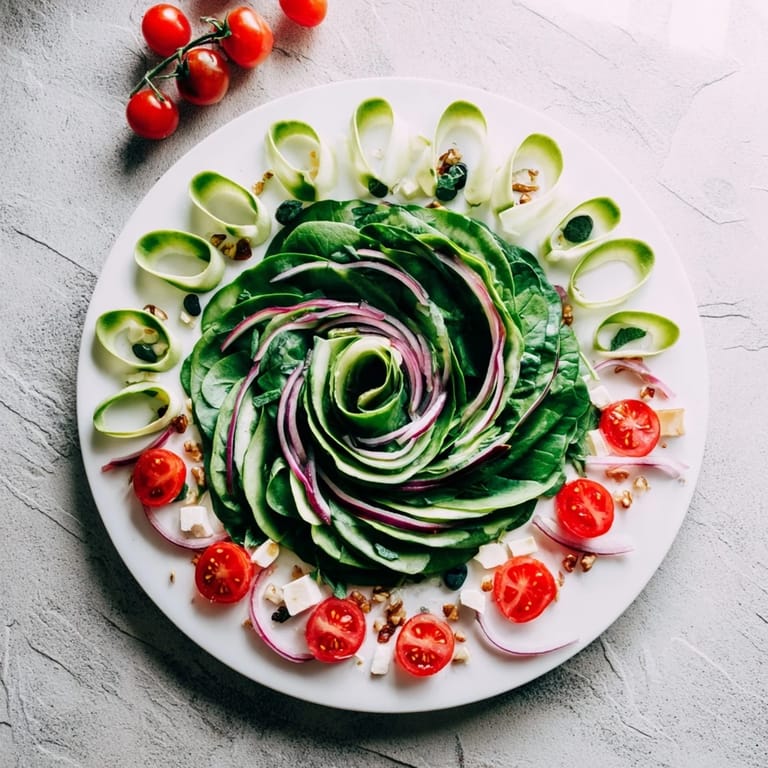
- Arrange baby spinach leaves in a crescent shape at the center of your platter, overlapping them slightly so they form a natural curve. This is your spiral's heart, so take a breath and trust the pattern.
- Build the arugula fan:
- Layer arugula in an expanding arc that overlaps the spinach, each leaf pointing outward like a sunrise. You'll notice how the peppery green becomes your second spiral ring.
- Continue the expanding rings:
- Add cherry tomato halves in the next section, then cucumber slices, then radishes, each arc slightly larger than the last. The Fibonacci ratio guides you, but don't get precious about it—your eye knows when it looks right.
- Add the onion accent:
- Scatter paper-thin red onion slices as a delicate ring near the outer edge, where they'll add visual contrast without overwhelming the spiral.
- Tuck in the soft elements:
- Nestle avocado slices and blueberries into the gaps throughout the spiral, spacing them so they catch your eye as you work your way inward. This is where you get to improvise a little.
- Finish with nuts and cheese:
- Sprinkle toasted walnuts and crumbled feta generously over the entire spiral, letting some pieces settle into crevices and others sit on top. Step back and admire for a moment—you've earned it.
- Whisk and dress:
- Combine olive oil, lemon juice, honey, and Dijon mustard in a small bowl, whisking until the honey dissolves and everything emulsifies slightly. Season with salt and pepper, tasting as you go.
- Dress just before serving:
- Drizzle the dressing evenly over the spiral moments before you bring it to the table, so every component stays crisp and the presentation stays intact. Watch someone's face light up as they see it fully dressed.
 Save to Pinterest
 My eight-year-old nephew asked if he could eat "the pretty spiral" and hesitated for only a second before digging in, which somehow made me realize this salad does something rare—it's beautiful enough to photograph but casual enough that nobody actually feels bad about messing it up by eating it. That's when I knew I'd created something worth repeating.
Why Arrangement Matters
The Fibonacci spiral isn't just pretty—it's actually a way to organize flavors so that every forkful has a chance of hitting something different. When ingredients are scattered randomly, you get pockets of sameness, but when they're arranged in expanding rings, your fork naturally travels through the spectrum. I learned this the hard way after my first attempt where I just threw everything on a platter and wondered why half my guests ended up with all tomatoes and no walnut. The spiral forced me to think about distribution, which made the eating experience so much better.
Playing with Variations
This salad is happiest when you treat it as a template rather than a rule book. I've swapped out the feta for goat cheese because my neighbor brought over a fresh round, and I've added shredded carrots during winter when I couldn't find good radishes. One night I threw in some thinly sliced fennel because I was curious, and it added this subtle licorice note that shouldn't have worked but absolutely did. The spiral format stays the same, but the cast of characters can change based on what's in your crisper drawer and what you're hungry for.
Making It a Meal
This salad started as a side dish, but I've found that adding protein transforms it into something that stands on its own. Grilled chicken breast sliced thin and arranged in another subtle arc works perfectly, as does a scattering of roasted chickpeas for vegetarian guests. Even some crumbled goat cheese if you're going rich, or a soft-boiled egg sliced and nestled into the spiral.
- For a complete meal, add grilled chicken, roasted chickpeas, or a poached egg without disrupting your spiral pattern.
- Remember that adding protein might shift your timing—you want hot proteins slightly cooled before they hit the cold greens.
- This is a salad that begs for crusty bread on the side to catch any extra dressing that pools on the plate.
 Save to Pinterest
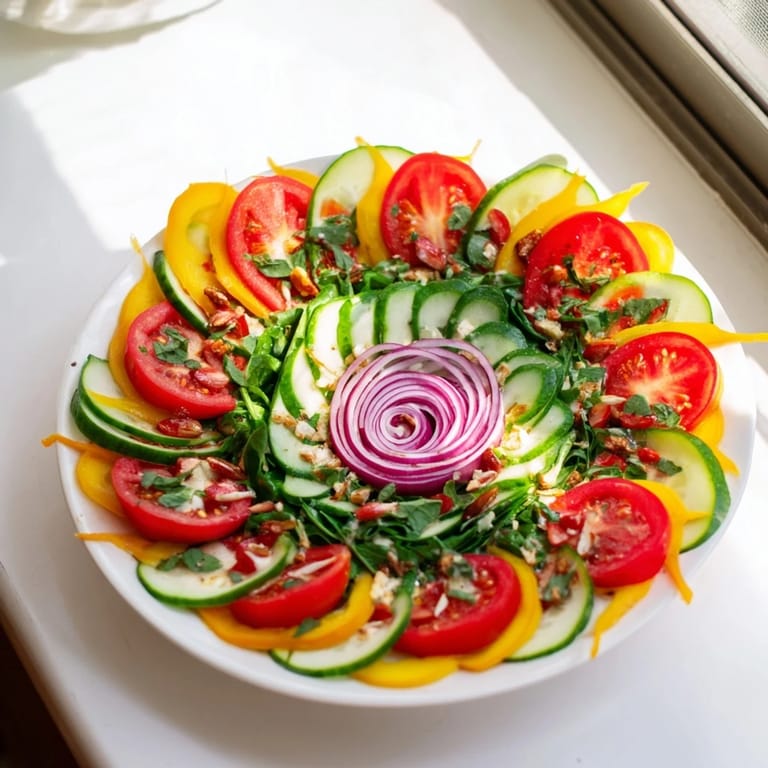
 This salad taught me that food doesn't need to be labor-intensive to feel special, and that sometimes the most meaningful meals are the ones where you take an extra five minutes to make something beautiful. Serve it proudly and watch people's faces change when they realize it's as delicious as it is stunning.
Recipe Questions
- → How do I arrange the ingredients to create the golden spiral effect?
Begin by placing spinach leaves in an innermost crescent, followed by overlapping arugula. Continue layering cherry tomatoes, cucumber, and radishes in expanding arcs, finishing with avocado and blueberries nestled into the spiral.
- → Can I substitute the feta cheese with another option?
Yes, goat cheese or other crumbly cheeses can be used as a flavorful alternative without compromising the dish’s texture.
- → What is the best way to dress the salad without overpowering the fresh ingredients?
Whisk together olive oil, lemon juice, honey, Dijon mustard, salt, and pepper, then drizzle evenly just before serving to maintain freshness and balance.
- → Are nuts necessary for this salad and can they be replaced?
Toasted walnuts add crunch and flavor complementing the other ingredients, but they can be omitted or swapped with other nuts like pecans if preferred.
- → How should this salad be served for best presentation and taste?
Arrange immediately before serving on a large round platter to showcase the spiral design and maintain crispness of the fresh produce.